"Plastic OK sir?"
"No paper bags please!"
Its not very common to hear these words in Houston. So when I was done with my request, I looked around with a smug feeling of being a progressive induvidual. Alas! there were no young ladies to impress but only septugenerians rummaging through their coupon book and rifling through their bags for the cheque book. However, this false sense of complaceny was quickly deflated with my dad's first jaunt to the grocery store. Seeing the paper bags stack up in kitchen, he grabbed some of them and said he planned to reuse them instead of getting more paper bags. Later in the same week, he found a big cloth bag and decided he can do away with the paper bags completely and use this big comfortable cloth bag for his daily pickings.
As I reflected on my dad's action, I realised that his action was more a reflection of an upbringing without an excess than a concern for the environment. Growing up in India, we are always reminded of wastage of energy resources. Our parents reprimand us for simple things like keeping the faucet open while brushing the teeth, or keeping the light on in the bedroom when not using it. Why then do we forget these roots when we are transported to this land of abundance? You don't have to be educated or progressive to care for environment. You just have to learn to take what you want and not indulge in excesses.
Here is one simple thing which I came across recently, which doesn't take any effort to implement but can a huge impact on your energy consumption:
Unplug Chargers when not in use
Only 5% of the power drawn by a cell phone charger is used to charge the phone. The other 95% is wasted when it is left plugged into the wall. Read the following link to see the energy savings from an "unplugged" not in use charger. And if you are really interested and rich, you might wanna try this green plug.
Finally, here is a fine article in Slate, exposing the hypocrisy of the "Green" Beijing Olympics.
This reiterates my point that energy conservation is a much more convoluted issue than a simple take on your car's gas mileage.
Showing posts with label Nature. Show all posts
Showing posts with label Nature. Show all posts
Tuesday, April 15, 2008


Saturday, December 01, 2007
Think beyond MPG*
Consider 2 different personalities below
I. Joe Redneck grew up in a small super conservative town of Midland, Texas. Thanks to striking oil in his backyard, Joe reaped riches and soon moved to Houston. Now Joe drives a 10 mpg Hummer, lives in a mansion consuming MW's of energy. He does not care about the environment and doesn't believe in conservation of our natural resources. He never recyles and doesnt care about running faucets in his palace. He has never set foot outside Texas and is totally illiterate about other culture.
II. Allene Green, grew up in the super liberal neighbourhood of Berkeley, CA. He now lives in the city of San Francisco in a small condo and drives a Prius which gives him 50 mpg. His small condo is lit with energy saving bulbs and he utilies only 1 light at a time in his house. He recycles all the cans, and never uses a plastic bag. He takes public transportation wherever possible. He is a conservationist and a tree hugger. Allene is also a big fan of travelling, and makes several trips to international and local destinations every year and is very well learned.
After reading the first 2 stories, it is very easy for a common man to draw the conclusion that Joe Redneck doesnt give a damn about the environment, whereas Allene Green is 21st century thinker who believes in preserving the natural resources of this world. Yet if you were to do a complete examination of their lifestyles, you would notice that the fuel consumed by Allene's international and domestic pleasure trips well exceed that of Joe's Hummers consumption. For example Allene' last weekend round trip to NY and back was equivalent of driving Joe's Hummer for 1250 miles** - a feat Joe accomplishes in more than a month! Thus in stark contrast to your assumptions based on two extreme cases presented above, Allene's carbon foot print is actually much more than that of Joe's.
If this result startles you, read more. Allene also spends 10 extra minutes in shower compare to Joe....and pray how is the hot water heated? Allene also has a voracious appetite and eats more than Joe. All forms of food be it meat or vegetables need enormous amount of energy for harvesting, transportation and packing. These are just a few examples from our daily lives where Allene consumes more energy than Joe.
Saving energy and natural resources are not simple as the mpg of your car. It takes a more holistic approach. We all need to realise, that at certain level all of us are hypocritical. Some may be aware of it, some may be denial...but at the end of the day the only way to conserve our resources is to do our bit. It might be as simple as recycling, or keeping the tap running for 1 less minute, or consolidating your dirty laundry to wash them all at once instead of washing 1 sock at a time.
* MPG - Miles per gallon
** Assumption - SFO -NY roundtrip is 6000 miles @ 48 mpg.
I. Joe Redneck grew up in a small super conservative town of Midland, Texas. Thanks to striking oil in his backyard, Joe reaped riches and soon moved to Houston. Now Joe drives a 10 mpg Hummer, lives in a mansion consuming MW's of energy. He does not care about the environment and doesn't believe in conservation of our natural resources. He never recyles and doesnt care about running faucets in his palace. He has never set foot outside Texas and is totally illiterate about other culture.
II. Allene Green, grew up in the super liberal neighbourhood of Berkeley, CA. He now lives in the city of San Francisco in a small condo and drives a Prius which gives him 50 mpg. His small condo is lit with energy saving bulbs and he utilies only 1 light at a time in his house. He recycles all the cans, and never uses a plastic bag. He takes public transportation wherever possible. He is a conservationist and a tree hugger. Allene is also a big fan of travelling, and makes several trips to international and local destinations every year and is very well learned.
After reading the first 2 stories, it is very easy for a common man to draw the conclusion that Joe Redneck doesnt give a damn about the environment, whereas Allene Green is 21st century thinker who believes in preserving the natural resources of this world. Yet if you were to do a complete examination of their lifestyles, you would notice that the fuel consumed by Allene's international and domestic pleasure trips well exceed that of Joe's Hummers consumption. For example Allene' last weekend round trip to NY and back was equivalent of driving Joe's Hummer for 1250 miles** - a feat Joe accomplishes in more than a month! Thus in stark contrast to your assumptions based on two extreme cases presented above, Allene's carbon foot print is actually much more than that of Joe's.
If this result startles you, read more. Allene also spends 10 extra minutes in shower compare to Joe....and pray how is the hot water heated? Allene also has a voracious appetite and eats more than Joe. All forms of food be it meat or vegetables need enormous amount of energy for harvesting, transportation and packing. These are just a few examples from our daily lives where Allene consumes more energy than Joe.
Saving energy and natural resources are not simple as the mpg of your car. It takes a more holistic approach. We all need to realise, that at certain level all of us are hypocritical. Some may be aware of it, some may be denial...but at the end of the day the only way to conserve our resources is to do our bit. It might be as simple as recycling, or keeping the tap running for 1 less minute, or consolidating your dirty laundry to wash them all at once instead of washing 1 sock at a time.
* MPG - Miles per gallon
** Assumption - SFO -NY roundtrip is 6000 miles @ 48 mpg.
Thursday, October 25, 2007
SoCal Burns
The Santa Ana winds finally have subsided, but not before making 1000s homeless and
making a record 1 million people flee their homes. In a region where the 3 of the top 5
millionaire counties in the country lie, the fire has already wrecked damage tothe tune of $1 bn. The 15 simultaneous fires in southern california have collectively been dubbed as the worst fire in the history of California causing an evacuation of epic proportions. There is no official count of the death toll, but some sources confirm that atleast 7 people have died, and more than 100 injured.
It is a really shuddering thought to think about people returning home to burnt embers and ashes. Years of good memories were washed away for many, in minutes, by the engulfing
flames. Some had time to salvage their precious items, whereas others probably lost years
worth of hard-work and sweat in seconds. Insurance might buy back some warmth, but for most the sorrow is insurmountable and I can only hope that time will be the best healer.
As evacuees poured in, Qualcomm stadium in San Diego, became a refuge for all the homeless. But before one could start drawing an eerie analogy with New Orleans stadium post-katrina, the donations and volunteers poured in and transformed it into something much more amenable. Infact, if you read this report, you would believe a carnival was happening in San Diego. Natural disasters often bring out the generosity and compassion in humankind, and this incident was no different.
Growing up in India, I had never heard about this form of nature's wrath. When I moved to
US, I ended up spending time in the east coast where the trees either stayed green or were
covered with snow. Under these circumstances fire was never a possibility. Only on moving
west of the Rockies, I saw a terrain ripe for the fires - extreme dryness, high winds through canyons and passes, and dry extensive grasslands. I did not realise how dry it can get in Southern California, till I started using moisturizer in peak summer, and I have definitely seen single digit relative humidity percentage in winter.
However, I always failed to understand how fires could be started spontaneously. I always
thought that fires were started due to live cigarrete stubs or careless embers flying into dry wilderness. But after a few searches on google, I finally convinced myself to the fact that nature can start a fire by itself without any human assisstance. Often times high wind gusts through narrow passages pack enough heat and when the conditions are extremely dry, they can ignite a brush and start a huge fire. This same sequence of event was responisble for starting atleast 12 out of the 15 simultaneous fires in Cal.
Traditionally, Southern California has always faced the threat of wildfires. Just like the Midwest suffers from tornadoes and snowstorms or the gulf coast suffers from different categories of hurricanes, this part of the country faces the fiery threat of the nature. But the effects of this threat has been amplified off late, courtesy the high costs of homes driving people further into the desert lands and mountain tops. But technology and money can only buy so much...in the end man has to always play second fiddle to Mother Nature.
making a record 1 million people flee their homes. In a region where the 3 of the top 5
millionaire counties in the country lie, the fire has already wrecked damage tothe tune of $1 bn. The 15 simultaneous fires in southern california have collectively been dubbed as the worst fire in the history of California causing an evacuation of epic proportions. There is no official count of the death toll, but some sources confirm that atleast 7 people have died, and more than 100 injured.
It is a really shuddering thought to think about people returning home to burnt embers and ashes. Years of good memories were washed away for many, in minutes, by the engulfing
flames. Some had time to salvage their precious items, whereas others probably lost years
worth of hard-work and sweat in seconds. Insurance might buy back some warmth, but for most the sorrow is insurmountable and I can only hope that time will be the best healer.
As evacuees poured in, Qualcomm stadium in San Diego, became a refuge for all the homeless. But before one could start drawing an eerie analogy with New Orleans stadium post-katrina, the donations and volunteers poured in and transformed it into something much more amenable. Infact, if you read this report, you would believe a carnival was happening in San Diego. Natural disasters often bring out the generosity and compassion in humankind, and this incident was no different.
Growing up in India, I had never heard about this form of nature's wrath. When I moved to
US, I ended up spending time in the east coast where the trees either stayed green or were
covered with snow. Under these circumstances fire was never a possibility. Only on moving
west of the Rockies, I saw a terrain ripe for the fires - extreme dryness, high winds through canyons and passes, and dry extensive grasslands. I did not realise how dry it can get in Southern California, till I started using moisturizer in peak summer, and I have definitely seen single digit relative humidity percentage in winter.
However, I always failed to understand how fires could be started spontaneously. I always
thought that fires were started due to live cigarrete stubs or careless embers flying into dry wilderness. But after a few searches on google, I finally convinced myself to the fact that nature can start a fire by itself without any human assisstance. Often times high wind gusts through narrow passages pack enough heat and when the conditions are extremely dry, they can ignite a brush and start a huge fire. This same sequence of event was responisble for starting atleast 12 out of the 15 simultaneous fires in Cal.
Traditionally, Southern California has always faced the threat of wildfires. Just like the Midwest suffers from tornadoes and snowstorms or the gulf coast suffers from different categories of hurricanes, this part of the country faces the fiery threat of the nature. But the effects of this threat has been amplified off late, courtesy the high costs of homes driving people further into the desert lands and mountain tops. But technology and money can only buy so much...in the end man has to always play second fiddle to Mother Nature.
Sunday, August 19, 2007
Balance in Numbers
This post is kind of a coherent development of an idea (100 for a perfect place) initiated by my fellow blogger totti.
A lot of times when I sit in a bumper to bumper traffic on a freeway, I wonder whether the world really needs to be this overcrowded ? How would our cities look, if instead of a population of 4 mn people we had only 400,000 ? Is there such thing as an optimum number of people in the world ? But then I realised that the word optimum itself is not absolute, but is subject to an objective function. For example, do we optimise to make everyone equally rich, or to have no dearth of natural sources, or to have adequate technology, or to make everyone happy. The objective function jumps the realm of science as some of the functions above, like happiness, can not even be expressed in numbers.
Since I definitely do not believe in intelligent design, lets say when human beings first evolved in their present form, there weren't very many of them. They were probably restricted to few isolated societies around the world. With time, man started his nomadic quest for riches and better life, and somewhere down the life the different societies became aware of each other. Some clashed and perished, some co-existed peacefully, but eventually the world became aware of various societies and after some negotiations, started trading globally.
Humans soon realised that division of labor and trading goods with each other made life much more rewarding and convenient. Hence, farmers in Ceylon could grow tea in excess and export it to their Europen comrades, while their Europeans counterparts exported their superior technology. Thus, the world got rid of unnecessary redundancy and humans started their pursuit of taming and creating the unknown.
There were some services which were critical and people filled them in first. For example, everyone needed farmers to grow and harvest crops. The world needed doctors to cure sick farmers, and the doctors needed engineers and architects to build their house and roads, while the engineers and architects needed rulers to rule and govern them all. But as the population grew, the society could not keep all the doctors, engineers and farmers busy. So people started diversifying and doing other things. Some became bankers to help people with their money, while some became entertainers to regale wary workers. Hitherto thought as pure pass time, sports now became a full fledged livelihood in itself, as people made a career out of it. Soon there were insurers, real estate agents, dolphin trainers, photographers and artists etc. The world now became a more enjoyable place courtesy the diversity wrought in by these new profession. In essence more people actually translated to more fun.
But the balance was never even in all societies. There were some societies which had just too many people tapping into strained resources. This lead to unemployment, poverty etc. On the other hand there were some societies with too little a crowd, which led to over dependence on other societies and in some cases paying a premium for their services. Globalisation continued to offset this disparity, but neverthless a balance could never be struck.
Inherently, I have always felt that more the people, more the number of occupations and fields of study that can be undertaken. So we can have, scientist studying the extinction of polar bears, or movie makers indulging in 3D graphics, or a lobbyist whose sole purpose is to perform propoganda for a particular subject. But our natural resources are limited and there in only so much oil or steel. But then again, necessity is the mother of invention, so shouldn't more people give rise to more technology - technology which helps us to understand mother nature better and thrive without exploiting her. The arguement soon falls into a vicious circle and I realise that there is no answer to the question that I am posing in this post. So should we just shun the idea of having an "optimum" number of people on this earth ?
ps: Totti, the word coherent, in the first line of the post was necessary!
A lot of times when I sit in a bumper to bumper traffic on a freeway, I wonder whether the world really needs to be this overcrowded ? How would our cities look, if instead of a population of 4 mn people we had only 400,000 ? Is there such thing as an optimum number of people in the world ? But then I realised that the word optimum itself is not absolute, but is subject to an objective function. For example, do we optimise to make everyone equally rich, or to have no dearth of natural sources, or to have adequate technology, or to make everyone happy. The objective function jumps the realm of science as some of the functions above, like happiness, can not even be expressed in numbers.
Since I definitely do not believe in intelligent design, lets say when human beings first evolved in their present form, there weren't very many of them. They were probably restricted to few isolated societies around the world. With time, man started his nomadic quest for riches and better life, and somewhere down the life the different societies became aware of each other. Some clashed and perished, some co-existed peacefully, but eventually the world became aware of various societies and after some negotiations, started trading globally.
Humans soon realised that division of labor and trading goods with each other made life much more rewarding and convenient. Hence, farmers in Ceylon could grow tea in excess and export it to their Europen comrades, while their Europeans counterparts exported their superior technology. Thus, the world got rid of unnecessary redundancy and humans started their pursuit of taming and creating the unknown.
There were some services which were critical and people filled them in first. For example, everyone needed farmers to grow and harvest crops. The world needed doctors to cure sick farmers, and the doctors needed engineers and architects to build their house and roads, while the engineers and architects needed rulers to rule and govern them all. But as the population grew, the society could not keep all the doctors, engineers and farmers busy. So people started diversifying and doing other things. Some became bankers to help people with their money, while some became entertainers to regale wary workers. Hitherto thought as pure pass time, sports now became a full fledged livelihood in itself, as people made a career out of it. Soon there were insurers, real estate agents, dolphin trainers, photographers and artists etc. The world now became a more enjoyable place courtesy the diversity wrought in by these new profession. In essence more people actually translated to more fun.
But the balance was never even in all societies. There were some societies which had just too many people tapping into strained resources. This lead to unemployment, poverty etc. On the other hand there were some societies with too little a crowd, which led to over dependence on other societies and in some cases paying a premium for their services. Globalisation continued to offset this disparity, but neverthless a balance could never be struck.
Inherently, I have always felt that more the people, more the number of occupations and fields of study that can be undertaken. So we can have, scientist studying the extinction of polar bears, or movie makers indulging in 3D graphics, or a lobbyist whose sole purpose is to perform propoganda for a particular subject. But our natural resources are limited and there in only so much oil or steel. But then again, necessity is the mother of invention, so shouldn't more people give rise to more technology - technology which helps us to understand mother nature better and thrive without exploiting her. The arguement soon falls into a vicious circle and I realise that there is no answer to the question that I am posing in this post. So should we just shun the idea of having an "optimum" number of people on this earth ?
ps: Totti, the word coherent, in the first line of the post was necessary!
Wednesday, May 03, 2006
Oil swell that ends well !
Nowadays, it's hard to hold more than 5 minutes of conversation without passing a wailing reference to the high gas prices. 74$ a barrel, 3.30$ Regular unleaded at the pump and it seems like only a brash word from Ahmadinejad or another explosion by Nigerian Militants separate us from 100$ a barrel (5.09$/ gallon gas !!).
A lot of people complain that India & China have increased their oil consumption drastically and thus driven up the demand. People fail to realise that USA, which in terms of population is 1/18th of these 2 nations put together, consumes more than 3 times of the total oil consumed by these countries together. Infact the US consumption continues to rise at a healthy rate of 3% per year. While US has traditionally hogged a disproportionate amount of world's natural resources, China and India are only seeking their fair share. I think the problem lies not in Asia, but in freeways outside our houses. There is no better example of the criminal waste of oil than the car crazy city of Los Angeles. 12 laned freeways, bumper to bumper traffic, with 98% of the cars with only 1 person inside them. No wonder, Southern California pays the highest gas prices in the country ! If only people realised that prices could be brought down by reducing demand, and not just by increasing supply, we could do much better at the gas station.
Some blame ExxonMobil, and the oil cartel created by major mergers of the huge company. Raymond Lee, the Exxon CEO's $400 mn retirement package only ended up adding fuel to the fire. Last year Exxon made the highest profit ever by any corporation in the US History. Duh! It's a $370 bn company, even a moderate 9% profit is enough to break the record. Infact companies like GE, Citigroup, Apple, Google all operate with a much higher profit percentage. Rex Tillerson, the CEO of Exxon, unabashedly claimed that his first priorty is to create value for investors, not to reduce gas prices. Welcome to the Capitalist Economy. Rather than blaming the huge corporations, people should introspect and think about the politicians they elect. People voted for Republicans, and they got what they asked for - a corporation friendly government.
I think rather than blaming all the external factors, we should start changing our habits and do our bit to curb oil consumption. Some of the habits that I have cultivated over the last 2 weeks, 1) Drive at 65 mph, instead of cruising above 70 mph - this will save atleast 2-3% gas consumption. 2) Curb your instincts on the freeway ramps. 0-60 mph in 7 s might be more fun than 0-60 mph in 9 s, but it also consumes more gas. Is 2 s worth it ? A simple calculation yeils that if I increase my mileage from 22 mph to 23 mph and drive the average 15,000 miles at $3 a gallon, I could save almost 100$ a year !!
A lot of people complain that India & China have increased their oil consumption drastically and thus driven up the demand. People fail to realise that USA, which in terms of population is 1/18th of these 2 nations put together, consumes more than 3 times of the total oil consumed by these countries together. Infact the US consumption continues to rise at a healthy rate of 3% per year. While US has traditionally hogged a disproportionate amount of world's natural resources, China and India are only seeking their fair share. I think the problem lies not in Asia, but in freeways outside our houses. There is no better example of the criminal waste of oil than the car crazy city of Los Angeles. 12 laned freeways, bumper to bumper traffic, with 98% of the cars with only 1 person inside them. No wonder, Southern California pays the highest gas prices in the country ! If only people realised that prices could be brought down by reducing demand, and not just by increasing supply, we could do much better at the gas station.
Some blame ExxonMobil, and the oil cartel created by major mergers of the huge company. Raymond Lee, the Exxon CEO's $400 mn retirement package only ended up adding fuel to the fire. Last year Exxon made the highest profit ever by any corporation in the US History. Duh! It's a $370 bn company, even a moderate 9% profit is enough to break the record. Infact companies like GE, Citigroup, Apple, Google all operate with a much higher profit percentage. Rex Tillerson, the CEO of Exxon, unabashedly claimed that his first priorty is to create value for investors, not to reduce gas prices. Welcome to the Capitalist Economy. Rather than blaming the huge corporations, people should introspect and think about the politicians they elect. People voted for Republicans, and they got what they asked for - a corporation friendly government.
I think rather than blaming all the external factors, we should start changing our habits and do our bit to curb oil consumption. Some of the habits that I have cultivated over the last 2 weeks, 1) Drive at 65 mph, instead of cruising above 70 mph - this will save atleast 2-3% gas consumption. 2) Curb your instincts on the freeway ramps. 0-60 mph in 7 s might be more fun than 0-60 mph in 9 s, but it also consumes more gas. Is 2 s worth it ? A simple calculation yeils that if I increase my mileage from 22 mph to 23 mph and drive the average 15,000 miles at $3 a gallon, I could save almost 100$ a year !!
Thursday, April 06, 2006
We(a)ther it matters ?
I spent the better part of my first 17 years growing up in Mumbai. Mumbai would get hot, sometimes really hot in summer, but I wouldn't complain. As a kid, summer holidays were time to go out and have fun. The mercury had no impact on the enthusiasm. My favorite season was the monsoon season, when it would rain regularly for almost 3 months. I remember getting drenched and playing soccer on days when school would get cancelled due to excessive flooding. As a kid, I never complained about the weather, cause I had not seen much outside Mumbai, and my limited knowledge of weather patterns were gathered only through geography textbooks. I learn't that it snowed in Tundra region, it goes to 50C in Sahara and it rains non-stop in Congo. Given these, Mumbai was a heaven.
When I moved to Chennai for the first time, I realised what bad weather could be like.
Chennai had only 3 season - Hot, Hotter & Hottest. The summers were brutal, there was no
monsoon - a little bit of rain and there would be flooding and chaos across the city and I
was happy that my stay there extended only 4 years.
It was then that I crossed the seven seas and set my foot in Pennsylvania. The welcome
fall weather was soon replaced by a frigid winter. The winter contained an entire month of sub-zero high temperatures. 6 months were spent shuttling between Apartment & Department, as all activities came to stand-still. Huddled up in 3-4 layers, I would nostalgically recall the days from Mumbai where I could roam around in T-shirt all year around. The fall and Summer in PA where no doubt wonderful, but then, it constitued only about 50% of the year. By now, I was fully aware of bad weather patters, but I was yet to see a place which has pleasant weather all year around.
When I moved to Los Angeles, the only thing I knew about California was that it doesn't snow, and hence it was going to be a welcome change. My lab mate once told me that the temp in LA stays 75F throughout the year, but I didn't care much, I was just relieved to move to a place where I dont have to face a harsh winter. But only when you experience the weather in Southern California do you come to realise what a good weather should be. Coastal California doesn't get more than 80F in summer, and even these days are supported by cool pacific breeze. The winter low temps dont drop below 45F. In the last 6 months, I have never used my fan, and only used the heater about 10-15 times!.
San Francisco might see days when mercury dips to 38F with overcast skies, Inland Los Angeles might see days when mercury soars to 100F (thanks to mountains), but in my opinion San Diego, probably has the best weather all year around. 75F/50F, Sunny Clear skies - that's your weather forecast 330 days a year !
....It took me 23 yrs to realise this, but with prices like these (ordinary 3 bedroom houses outside my apt), I am just a temporary visitor in this Golden State.
When I moved to Chennai for the first time, I realised what bad weather could be like.
Chennai had only 3 season - Hot, Hotter & Hottest. The summers were brutal, there was no
monsoon - a little bit of rain and there would be flooding and chaos across the city and I
was happy that my stay there extended only 4 years.
It was then that I crossed the seven seas and set my foot in Pennsylvania. The welcome
fall weather was soon replaced by a frigid winter. The winter contained an entire month of sub-zero high temperatures. 6 months were spent shuttling between Apartment & Department, as all activities came to stand-still. Huddled up in 3-4 layers, I would nostalgically recall the days from Mumbai where I could roam around in T-shirt all year around. The fall and Summer in PA where no doubt wonderful, but then, it constitued only about 50% of the year. By now, I was fully aware of bad weather patters, but I was yet to see a place which has pleasant weather all year around.
When I moved to Los Angeles, the only thing I knew about California was that it doesn't snow, and hence it was going to be a welcome change. My lab mate once told me that the temp in LA stays 75F throughout the year, but I didn't care much, I was just relieved to move to a place where I dont have to face a harsh winter. But only when you experience the weather in Southern California do you come to realise what a good weather should be. Coastal California doesn't get more than 80F in summer, and even these days are supported by cool pacific breeze. The winter low temps dont drop below 45F. In the last 6 months, I have never used my fan, and only used the heater about 10-15 times!.
San Francisco might see days when mercury dips to 38F with overcast skies, Inland Los Angeles might see days when mercury soars to 100F (thanks to mountains), but in my opinion San Diego, probably has the best weather all year around. 75F/50F, Sunny Clear skies - that's your weather forecast 330 days a year !
....It took me 23 yrs to realise this, but with prices like these (ordinary 3 bedroom houses outside my apt), I am just a temporary visitor in this Golden State.
Monday, December 05, 2005
An Ode to the Mountains
On a sunny saturday afternoon, I was absorbing the majestic site of the San Gabriel mountains while playing cricket at the foothills of this mountaineous range. There is something about the mountains which always makes me look at them with awe. They have stood tall for thousands of years, and seen life evolve and develop on this earth. They stand silent, weathering all seasons, good times and bad, but never change. Some times they are engulfed in clouds, sometimes they are covered with snow, sometimes they are green and colorful, and at other times they are barren, nevertheless they never fail to beautify the topography.
Growing up in Bombay, I had never been exposed to the sight of tall beautiful mountains. My only brush with anything resembling mountains were during my travel through the Khandala ghats were train would wind through a hilly terrain looking up at peaks the highest of which wouldn't exceed 2,500 ft.
Naturally, when I moved to Pennsylvania, I was in awe of the mountains that lined the state. Most of the highways would snake through scenic mountain ranges measuring anything between 2500 - 4000 ft. The fall foliage would add further beauty to these hills. One such drive is captured in the snap below.
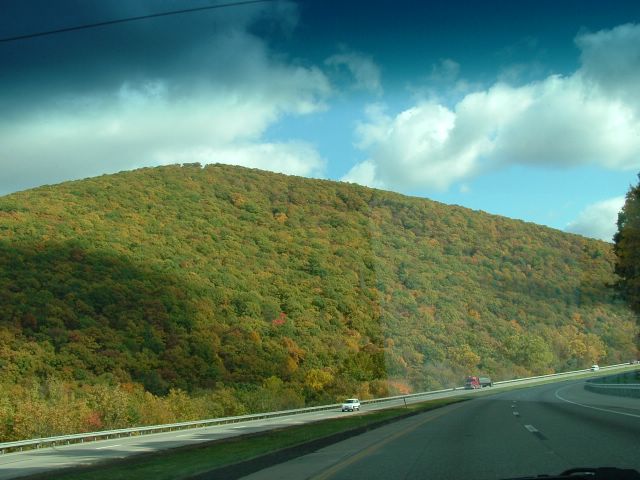
I-80 in PA
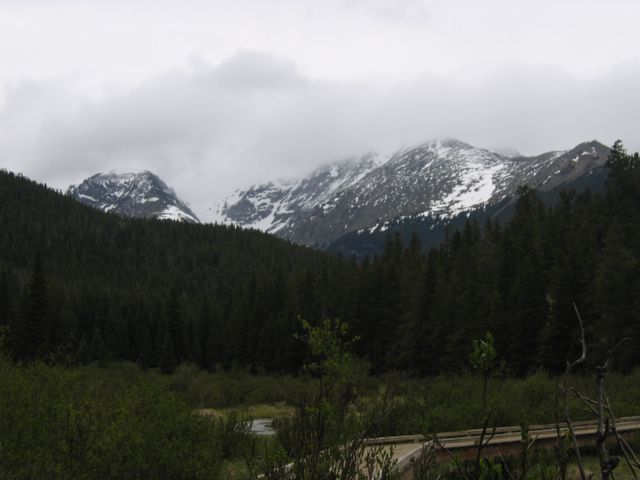
Rocky Mountain Natl Park
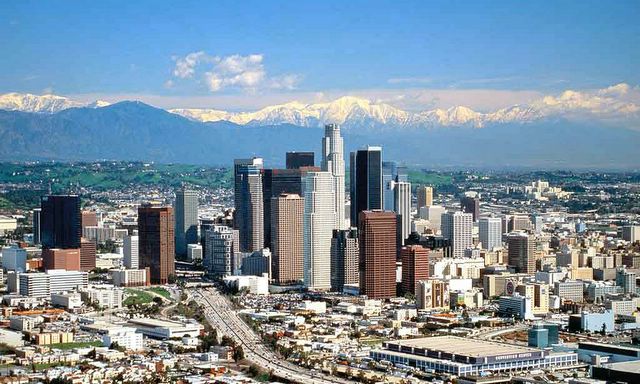
LA skyline with the snow clad San Bernardino mountains in the background
After seeing these mountains, I can only imagine the beauty of Himalayas in Kashmir.
Tuesday, September 20, 2005
Human Nature
2073 AD.
A category 5 hurricane is rapidly advancing over the Gulf of Mexico and is expected to pound the city of New Orleans in next 48 hours. 68 years ago, this city was devastated by a hurricane named 'Katrina'. The resilence of the Orlenanians and magnanimity of the Americans had enabled the city to be rebuilt within a year after this catastrophy. 'Katrina' had claimed more than 100o lives and damaged property worth $200 bn. Although the memory of that tragedy is still fresh amongst the residents of this great city, the residents are least bit concerned about this force of nature. Infact excited citizens listen carefully to the national broadcast by President Spencer, informing them that the situation is well under control. The president assures the world that the US Meterology dept and the US Military have already sent out 12 of their "Terminix" flights into the gulf to divert, if not destroy, hurricane 'Dennis' before it reaches the Southeastern states. The flights are empowered with highly advanced flow acoustics program to enter the eye of hurricane and reduce its intensity by reversing the flow of the wind. Under normal circumstances, it would take these 12 "Terminix"es a little more than 5 hours to reduce 'Dennis' into a warm gulf draft - reduce its speed from 130 mph to a mere 15 mph. This is 2073 AD, science has advanced enough to help man conquer what seems like a final boundary - Mother Nature !!
Since the time the first Homo Erectus walked on planet earth, human beings have always tried to study and better understand their surroundings. Some studied the phenomenon of trees rubbing against each other and learnt to create fire, while the more advanced saw apple falling off a tree and formulated the gravitational theory. An inquisitive mind and a burning desire to learn about the forces of nature, enabled mankind to not only predict it, but also learn enough about it to use it to their advantage. Equipped with this knowledge humans conquered the air, sea, the land and all those unexplored parts of the world. Giant strides were taken in the field on Telecomunications, Transportation, Economics and the world was brought closer. Infact, man had even become capable of influencing or damaging the nature. The limits of natural resources like coal, oil etc were reached. The ozone layer was damaged and the harmful ultraviolet rays were ushered into our atmosphere. Acid rains had destroyed natural vegetation, while defforestation caused landslides and floods. The doomsday sayers were chanting the mantra of Global Warming and predicting the end of the world.
But the indomitable human spirit overcame all the obstacles and helped push the envelope of technology even further. By the middle of the 21st century, Human beings started controlling the nature. They could produce rains in drought prone regions. They could control the amount of sunshine over a tiny block of apartments. Hurricanes could be stopped at will, and some evil nations even started developing tornadoes to torment their enemies. There were no heat waves, or cold fronts, or floods in the world. The whole world was now a set of "Truman" show and the Prime Ministers and Presidents decided what season their country should experience at any given time of the year. However, people had the option of electronically controlling the weather conditions in their front yard.
Wishful thinking ? Well, only time will tell. Incidentally, after taming Mother Nature, mankind would set its sight on controlling the flow of time !
A category 5 hurricane is rapidly advancing over the Gulf of Mexico and is expected to pound the city of New Orleans in next 48 hours. 68 years ago, this city was devastated by a hurricane named 'Katrina'. The resilence of the Orlenanians and magnanimity of the Americans had enabled the city to be rebuilt within a year after this catastrophy. 'Katrina' had claimed more than 100o lives and damaged property worth $200 bn. Although the memory of that tragedy is still fresh amongst the residents of this great city, the residents are least bit concerned about this force of nature. Infact excited citizens listen carefully to the national broadcast by President Spencer, informing them that the situation is well under control. The president assures the world that the US Meterology dept and the US Military have already sent out 12 of their "Terminix" flights into the gulf to divert, if not destroy, hurricane 'Dennis' before it reaches the Southeastern states. The flights are empowered with highly advanced flow acoustics program to enter the eye of hurricane and reduce its intensity by reversing the flow of the wind. Under normal circumstances, it would take these 12 "Terminix"es a little more than 5 hours to reduce 'Dennis' into a warm gulf draft - reduce its speed from 130 mph to a mere 15 mph. This is 2073 AD, science has advanced enough to help man conquer what seems like a final boundary - Mother Nature !!
Since the time the first Homo Erectus walked on planet earth, human beings have always tried to study and better understand their surroundings. Some studied the phenomenon of trees rubbing against each other and learnt to create fire, while the more advanced saw apple falling off a tree and formulated the gravitational theory. An inquisitive mind and a burning desire to learn about the forces of nature, enabled mankind to not only predict it, but also learn enough about it to use it to their advantage. Equipped with this knowledge humans conquered the air, sea, the land and all those unexplored parts of the world. Giant strides were taken in the field on Telecomunications, Transportation, Economics and the world was brought closer. Infact, man had even become capable of influencing or damaging the nature. The limits of natural resources like coal, oil etc were reached. The ozone layer was damaged and the harmful ultraviolet rays were ushered into our atmosphere. Acid rains had destroyed natural vegetation, while defforestation caused landslides and floods. The doomsday sayers were chanting the mantra of Global Warming and predicting the end of the world.
But the indomitable human spirit overcame all the obstacles and helped push the envelope of technology even further. By the middle of the 21st century, Human beings started controlling the nature. They could produce rains in drought prone regions. They could control the amount of sunshine over a tiny block of apartments. Hurricanes could be stopped at will, and some evil nations even started developing tornadoes to torment their enemies. There were no heat waves, or cold fronts, or floods in the world. The whole world was now a set of "Truman" show and the Prime Ministers and Presidents decided what season their country should experience at any given time of the year. However, people had the option of electronically controlling the weather conditions in their front yard.
Wishful thinking ? Well, only time will tell. Incidentally, after taming Mother Nature, mankind would set its sight on controlling the flow of time !
Subscribe to:
Posts (Atom)